« Advanced Double Crankset Conversion » : différence entre les versions
Aucun résumé des modifications |
|||
| Ligne 104 : | Ligne 104 : | ||
| 107 (?) | | 107 (?) | ||
| 102,5 | | 102,5 | ||
| | | 103mm Neco B910/B920/B940CT<ref>{{cite web |url= https://web.archive.org/web/20240426151909/https://www.necoparts.com/Templates/att/2023-2024%20Catalogue%20Updated.pdf?lng=en |title= Neco 2023-2024 Catalogue }}</ref> | ||
(28mm) | |||
| | | | ||
|- | |- | ||
| Ligne 111 : | Ligne 112 : | ||
| 113 (31) | | 113 (31) | ||
| 105.5 (26.25) | | 105.5 (26.25) | ||
| | | 103 mm Neco B910/B920/B940<ref>{{cite web |url= https://web.archive.org/web/20240426151909/https://www.necoparts.com/Templates/att/2023-2024%20Catalogue%20Updated.pdf?lng=en |title= Neco 2023-2024 Catalogue }}</ref> | ||
(28mm) | |||
| | | | ||
|- | |- | ||
| Ligne 125 : | Ligne 127 : | ||
| 113 (30.5) | | 113 (30.5) | ||
| 105.5 (26.75) | | 105.5 (26.75) | ||
| | | 103mm Neco B910/B920/B940<ref>{{cite web |url= https://web.archive.org/web/20240426151909/https://www.necoparts.com/Templates/att/2023-2024%20Catalogue%20Updated.pdf?lng=en |title= Neco 2023-2024 Catalogue }}</ref> | ||
(28mm) | |||
| | | | ||
|- | |- | ||
| Ligne 132 : | Ligne 135 : | ||
| 113 (30.5) | | 113 (30.5) | ||
| 105.5 (26.75) | | 105.5 (26.75) | ||
| | | 103mm Neco B910/B920/B940<ref>{{cite web |url= https://web.archive.org/web/20240426151909/https://www.necoparts.com/Templates/att/2023-2024%20Catalogue%20Updated.pdf?lng=en |title= Neco 2023-2024 Catalogue }}</ref> | ||
(28mm) | |||
| | | | ||
|- | |- | ||
| Ligne 139 : | Ligne 143 : | ||
| 113 (31) | | 113 (31) | ||
| 105.5 (26.25) | | 105.5 (26.25) | ||
| | | 103mm Neco B910/B920/B940<ref>{{cite web |url= https://web.archive.org/web/20240426151909/https://www.necoparts.com/Templates/att/2023-2024%20Catalogue%20Updated.pdf?lng=en |title= Neco 2023-2024 Catalogue }}</ref> | ||
(28mm) | |||
| | | | ||
|- | |- | ||
| Ligne 153 : | Ligne 158 : | ||
| 110 (?) | | 110 (?) | ||
| 103.5 | | 103.5 | ||
| | | 103mm Neco B910/B920/B940CT<ref>{{cite web |url= https://web.archive.org/web/20240426151909/https://www.necoparts.com/Templates/att/2023-2024%20Catalogue%20Updated.pdf?lng=en |title= Neco 2023-2024 Catalogue }}</ref> | ||
(28mm) | |||
| | | | ||
|- | |- | ||
| Ligne 160 : | Ligne 166 : | ||
| 112 (32.5) | | 112 (32.5) | ||
| 104.5 (28.75) | | 104.5 (28.75) | ||
| | | 108mm Neco B910/B920/B940<ref>{{cite web |url= https://web.archive.org/web/20240426151909/https://www.necoparts.com/Templates/att/2023-2024%20Catalogue%20Updated.pdf?lng=en |title= Neco 2023-2024 Catalogue }}</ref> | ||
(29mm) | |||
| | | | ||
|- | |- | ||
| Ligne 167 : | Ligne 174 : | ||
| 112 (32.5) | | 112 (32.5) | ||
| 104.5 (28.75) | | 104.5 (28.75) | ||
| | | 108mm Neco B910/B920/B940<ref>{{cite web |url= https://web.archive.org/web/20240426151909/https://www.necoparts.com/Templates/att/2023-2024%20Catalogue%20Updated.pdf?lng=en |title= Neco 2023-2024 Catalogue }}</ref> | ||
(29mm) | |||
| | | | ||
|- | |- | ||
| Ligne 174 : | Ligne 182 : | ||
| 112 (32.5) | | 112 (32.5) | ||
| 104.5 (28.75) | | 104.5 (28.75) | ||
| | | 108mm Neco B910/B920/B940<ref>{{cite web |url= https://web.archive.org/web/20240426151909/https://www.necoparts.com/Templates/att/2023-2024%20Catalogue%20Updated.pdf?lng=en |title= Neco 2023-2024 Catalogue }}</ref> | ||
(29mm) | |||
| | | | ||
|} | |} | ||
| Ligne 181 : | Ligne 190 : | ||
Most of the recommended bottom brackets come from Neco. They offer a lot of different dimensions, and some of them are weird to say the least : if you look at the B920HAL, the first two Bottom Bracket dimensions are 107.5mm and 110.5mm. Yet both drive side axle length are 20.5mm, the box being the same 68mm, the difference comes from the length of the non-drive side : 19mm vs 22.5mm. In general, it is better to go with a matching (or closer) drive-side axle length than a matching (or closer) total axle length and then go with the non-drive side as close to the drive side as possible, to get closer to a symmetric bottom bracket. | Most of the recommended bottom brackets come from Neco. They offer a lot of different dimensions, and some of them are weird to say the least : if you look at the B920HAL, the first two Bottom Bracket dimensions are 107.5mm and 110.5mm. Yet both drive side axle length are 20.5mm, the box being the same 68mm, the difference comes from the length of the non-drive side : 19mm vs 22.5mm. In general, it is better to go with a matching (or closer) drive-side axle length than a matching (or closer) total axle length and then go with the non-drive side as close to the drive side as possible, to get closer to a symmetric bottom bracket. | ||
== Conversion table between 68mm and 50mm B-dimension bottom bracket dimensions == | |||
{| class="wikitable centre" style="margin-left: auto; margin-right: auto; border: none;text-align:center;" | |||
|- | |||
! total length | |||
! A | |||
! B | |||
! C | |||
|- | |||
| 103 (50) | |||
| 25 | |||
| 50 | |||
| 28 | |||
|- | |||
| 103 (68) | |||
| 16,5 | |||
| 68 | |||
| 18,5 | |||
|- | |||
| 107,5 (50) | |||
| 27,5 | |||
| 50 | |||
| 30 | |||
|- | |||
| 107,5 (68) | |||
| 19 | |||
| 68 | |||
| 20,5 | |||
|- | |||
| 108 (50) | |||
| 29 | |||
| 50 | |||
| 29 | |||
|- | |||
| 108 (68) | |||
| 20,5 | |||
| 68 | |||
| 19,5 | |||
|} | |||
= Practice = | = Practice = | ||
Version du 28 avril 2024 à 10:05
The main hurdle to converting a road bike to a single sprocket bicycle (fixed gear or single freewheel) is to get the correct chain line. While many simply put their main chainring on the innermost placement of their double chainring and call it good enough, chainline is something that can be calculated and the aforementioned practice can be avoided. The issue about chainline is the fact that it's quite an abstract concept considering it's a fixed dimension that depends on two variable dimensions. Manufacturers don't make it easier because they usually tell both dimensions determine the chainline. For exemple, you will find the chainline in the specifications of either Bottom Brackets or Cranks depending on manufacturer, crankset, bottom bracket and even then, there is no real standard to how a chainline works and what it depends on. In this article, we're going to theorise the length of the bottom bracket needed to turn a double crankset into a single chainring crankset. We will focus on square axle bottom brackets as they are the most common type of BB used in conversions.
Theory
What are chainlines ?
The basic gist of a chainline is that it is the straight line from the crankset to the back sprockets. There are multiple chainlines because there are different use cases and different cranksets. Chainlines make for a starting point for the chain to pivot from on a multiple sprocket bike. It is meant to be a "middle-ground" amidst all possible combinations of gears and chainrings.
But first, let's try to define what we aim for : a single chainring chainline. The single chainring chainline is the distance between the middle of your chainring and the plane that cuts your bike in half from one end to the other or to put it in a more telling way, the middle of your seat tube. It is meant to be as straight as possible from the chainring to the sprocket as these two points are the only possible positions.
The most common Single Chainring chainline is 42,5mm.
Now let's try to define what we're starting from : a double chainring chainline. The double chainring chainline is the distance between the middle of the space between your two chainrings and the same plane as before. Where it deviates in definition to the Single Chainring chainline is that there are two pivot points in a double chainring drivetrain. The chainline serves the same purpose : a middle-ground, but as the chain is a flexible component and as there are multiple sprockets, the double chainring system allows for multiple positions. Even in the optimal use cases, the line from the chainring to the chosen sprocket may not be straight. In fact, you can deviate from the recommended chainline and still keep a perfectly fine drivetrain.
The most common Double Chainring chainline is 43,5mm. It is the Shimano standard.
-
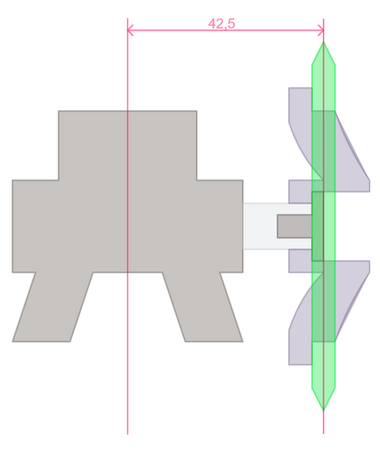 42,5mm single chainring chainline with single chainring crankset
 -
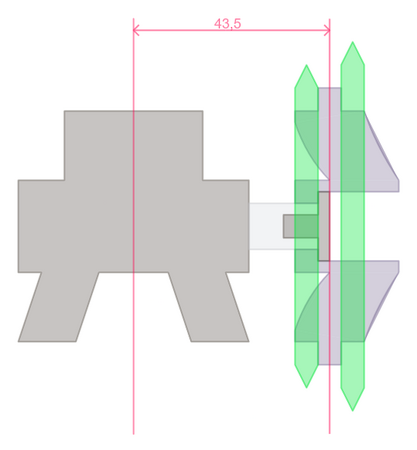 43,5mm double chainring chainline with double chainring crankset


How are chainlines ?
Chainlines are physically defined by the drive-side length of the axle from the middle of axle (same plane mentioned before) and where the chainring is situated on the crank, whether the crank forms a more or less concave element. Which is why different cranksets can require bottom brackets of different lengths while keeping the same chainline.
As bottom brackets come in many different lengths, we can shorten the required length of the bottom bracket from a double chainring crankset to account for the difference in the concave-ness between a single-chainring crank and a double-chainring crank and therefore give a double-chainring crank a single-chainring chainline.
-
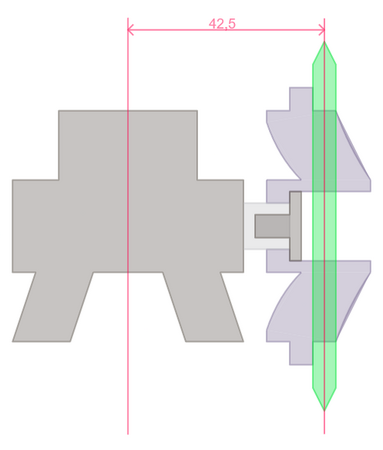 42,5mm single chainring chainline with double chainring crankset

Where to start from ?
It is important to note we will only talk about bottom brackets for traditional 68mm wide threaded bottom bracket boxes. We also only will talk about Double-Chainring Cranksets. No Triple.
The start of the journey to theorise this entreprise is a double chainring crankset being used a single chainring crankset, with all 68mm bottom bracket dimensions mentioned and both chainlines we talked about above.
In this case, we're going to take the case of the Stronglight 107 crankset, according to the 1984 Stronglight No. 27 catalogue[1] :
| Width of the bottom bracket box | Length of the bottom bracket axle | A (mm) | B (mm) | C (mm) | chainline |
|---|---|---|---|---|---|
| 68 | 113 | 28,5 | 56 | 28,5 | Track |
| 68 | 118,5 | 30,25 | 56 | 32,25 | 43,5 |
-
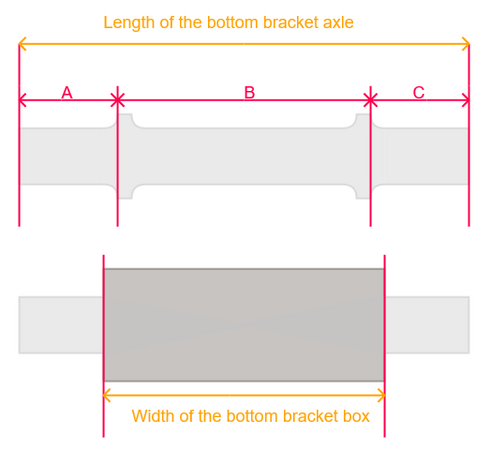 Legend of the table

Drawing Conclusions
Now, the mathematics of the theory are quite simple : if you start from a 43,5mm chainline double chainring crankset, you only need to take 3,75mm off the drive-side of the axle. Seeing as you can have a symmetric axle, you can double that and substract the original length of the axle by the 7,5mm and you should have the perfect axle length.
The issues stem from the dimensions given by the manufacturers and the different types of bottom brackets nowadays. The days of adjustable bottom bracket like the ones the 107 used are long gone, and while dimensions shouldn't suffer from it, as the bottom bracket box dimensions are still the same and the chainline remains the same, the cups and bearings have changed. It's hard to find schematics of a brand new bottom bracket that are as simple and precise as the ones from the Stronglight catalog. So, much of what will follow is strictly theory and there will be trial and error if you seek the perfect chainline.
The goal of this article is to give an insight on what can be done to go a little further than simply placing your chainring on the inner placement of a double-chainring crankset that's meant to hold two of them. As such, we will go a little deeper and give examples that should work.
Addressing different chain standards
There are different sizes of chains : 1/2"x3/32" (usually mentioned as 2,38 in french catalogues) and 1/2"x1/8" (usually mentioned as 3,17 in french catalogues). The first size, 3/32", was used for a long time ONLY for multiple sprockets drivetrains and 1/8" ONLY for single speed drivetrains. But nowadays the difference is almost inexistant as using a 3/32" chain for a single speed is totally feasible and even featured since the mid-80s on the Dura-Ace FC-7600 groupset.
I mention this because the difference in width of the chainring between the two sizes could be mentioned as a possible error in the mathematics. But it's accounted for as visibly, the catalogue mentions each size of chain for each use of the 107 crankset.
Hypotheses
Here is a list of a few cranksets, the associated bottom bracket and its length, the length of the drive side of the axle, the recommended length for a conversion with an exemple of available bottom brackets and what the measured chainline is. This will serve as a database for the fixed gear cyclist on a budget that has a totally functionning double-chainring crankset and wants to use it for his fixed-gear bike conversion.
| Model of crankset | Associated bottom bracket | Length (drive side length) | Converted Length (new drive side length) | Recommended bottom bracket length (drive side length) | Measured chainline of the conversion |
|---|---|---|---|---|---|
| Stronglight 107 | |||||
| Shimano FC-A551 | BB-UN52 | 107 (?) | 102,5 | 103mm Neco B910/B920/B940CT[2]
(28mm) |
|
| Shimano FC-A550 | BB-A550 | 113 (31) | 105.5 (26.25) | 103 mm Neco B910/B920/B940[3]
(28mm) |
|
| Shimano FC-A415 | BB-UN52 | 107 (?) | 99.5 | ||
| Shimano FC-1050 | BB-1050 | 113 (30.5) | 105.5 (26.75) | 103mm Neco B910/B920/B940[4]
(28mm) |
|
| Shimano FC-1051 | BB-1050 | 113 (30.5) | 105.5 (26.75) | 103mm Neco B910/B920/B940[5]
(28mm) |
|
| Shimano FC-1055 | BB-1055 | 113 (31) | 105.5 (26.25) | 103mm Neco B910/B920/B940[6]
(28mm) |
|
| Shimano FC-1056 | BB-UN52 | 107 (?) | 99.5 | ||
| Shimano FC-4400 | BB-UN52 | 110 (?) | 103.5 | 103mm Neco B910/B920/B940CT[7]
(28mm) |
|
| Shimano FC-7400 | BB-7400 | 112 (32.5) | 104.5 (28.75) | 108mm Neco B910/B920/B940[8]
(29mm) |
|
| Shimano FC-7402 | BB-7400 | 112 (32.5) | 104.5 (28.75) | 108mm Neco B910/B920/B940[9]
(29mm) |
|
| Shimano FC-7402-SG | BB-7400 | 112 (32.5) | 104.5 (28.75) | 108mm Neco B910/B920/B940[10]
(29mm) |
Dimension Shenanigans
Most of the recommended bottom brackets come from Neco. They offer a lot of different dimensions, and some of them are weird to say the least : if you look at the B920HAL, the first two Bottom Bracket dimensions are 107.5mm and 110.5mm. Yet both drive side axle length are 20.5mm, the box being the same 68mm, the difference comes from the length of the non-drive side : 19mm vs 22.5mm. In general, it is better to go with a matching (or closer) drive-side axle length than a matching (or closer) total axle length and then go with the non-drive side as close to the drive side as possible, to get closer to a symmetric bottom bracket.
Conversion table between 68mm and 50mm B-dimension bottom bracket dimensions
| total length | A | B | C |
|---|---|---|---|
| 103 (50) | 25 | 50 | 28 |
| 103 (68) | 16,5 | 68 | 18,5 |
| 107,5 (50) | 27,5 | 50 | 30 |
| 107,5 (68) | 19 | 68 | 20,5 |
| 108 (50) | 29 | 50 | 29 |
| 108 (68) | 20,5 | 68 | 19,5 |
Practice
While we have gone in length on the complications of sourcing the bottom brackets with the correct axle length and made hypotheses about which crankset would work with some very specific brand new bottom brackets, in reality this practice is a LOT more common than we can imagine. Cheap "fixie" bikes very often use double-chainring cranksets with the sole chainring being on the outer placement. Good exemples stem from Bianchi's offering of fixie bikes[11]. The Bianchi "Pista Steel" uses a "FSA Tempo CK-200S" crankset (and the following year, this becomes a "FSA Tempo Track"[12]) and the "Pista Sei Giorni Alu" uses a "Truvatic TOURO Track 1.1" crankset. Both crankset are in every possible sense not designed to be used as either a single chainring crankset (despite the Track name used sometimes) or as a crankset with a 42,5mm chainline. Yet, I am sure that neither bike have a bent 42,5mm chainline. If anything both bikes are Proof of Concept that it works.
References
This template displays the list of footnotes at the end of an article and provides additional formatting and organizing options. After hitting "Apply changes" and turning back to VE read mode, you will not see the references list. After hitting "Publish page" and turning back to normal read mode the reference list will reappear with the changes applied, see T53146.
| Paramètre | Description | Type | État | |
|---|---|---|---|---|
| Columns / Column width | 1 colwidth | Two modes supported. First mode (deprecated): integer number of fixed columns into which the reference list is to be rendered. Second mode: typographic unit of measurement such as 'em', specifying the width for the reference list columns, e.g. '33em'; spaced '33 em' will not be recognized
| Chaîne | facultatif |
| Liststyle | liststyle | Specifies the style used when the reference list is enumerated; accepts any valid CSS value defined for list-style-type
| Chaîne | facultatif |
| Group | group | Group is an identifier which restricts the references that are shown. Without this parameter, this template only shows references with no group identifier. With a group identifier specified, only references with a matching group identifier are handled. The rest are left alone. | Chaîne | facultatif |
| List of references | refs | Provides a space to define named references for use in the article. References defined in this space are not shown unless used somewhere in the article. | Chaîne | facultatif |
- ↑ Erreur Lua dans Module:Citation/CS1/Configuration à la ligne 2058 : attempt to index field '?' (a nil value).
- ↑ Erreur Lua dans Module:Citation/CS1/Configuration à la ligne 2058 : attempt to index field '?' (a nil value).
- ↑ Erreur Lua dans Module:Citation/CS1/Configuration à la ligne 2058 : attempt to index field '?' (a nil value).
- ↑ Erreur Lua dans Module:Citation/CS1/Configuration à la ligne 2058 : attempt to index field '?' (a nil value).
- ↑ Erreur Lua dans Module:Citation/CS1/Configuration à la ligne 2058 : attempt to index field '?' (a nil value).
- ↑ Erreur Lua dans Module:Citation/CS1/Configuration à la ligne 2058 : attempt to index field '?' (a nil value).
- ↑ Erreur Lua dans Module:Citation/CS1/Configuration à la ligne 2058 : attempt to index field '?' (a nil value).
- ↑ Erreur Lua dans Module:Citation/CS1/Configuration à la ligne 2058 : attempt to index field '?' (a nil value).
- ↑ Erreur Lua dans Module:Citation/CS1/Configuration à la ligne 2058 : attempt to index field '?' (a nil value).
- ↑ Erreur Lua dans Module:Citation/CS1/Configuration à la ligne 2058 : attempt to index field '?' (a nil value).
- ↑ Erreur Lua dans Module:Citation/CS1/Configuration à la ligne 2058 : attempt to index field '?' (a nil value).
- ↑ Erreur Lua dans Module:Citation/CS1/Configuration à la ligne 2058 : attempt to index field '?' (a nil value).